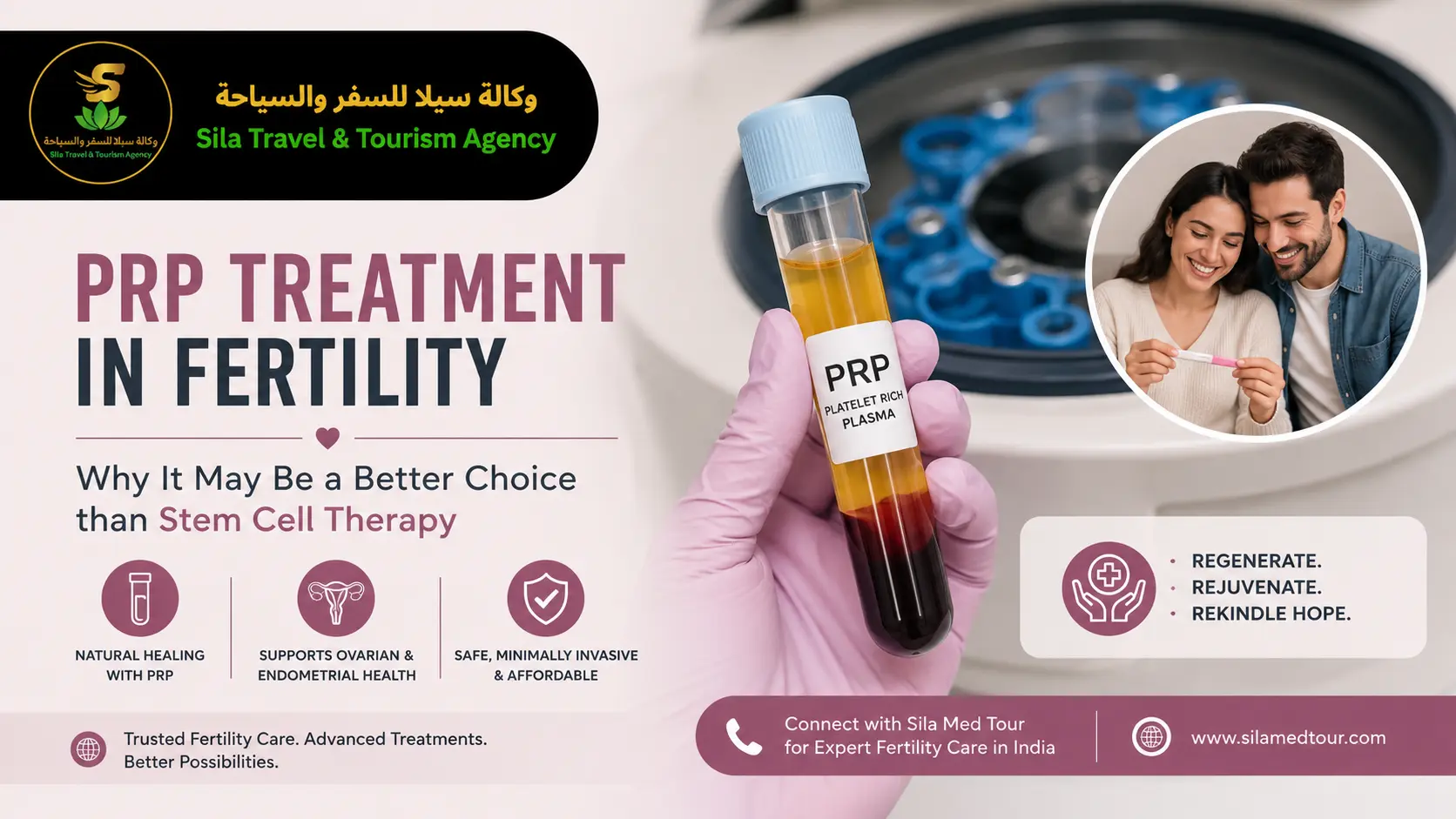
PRP vs. Stem Cell Therapy in Fertility: Why More Couples Are Choosing PRP Treatment
When couples struggle with infertility, every new treatment brings hope—but also questions. In recent years, two regenerative therapies have gained attention in reproductive medicine: Platelet-Rich Plasma (PRP) Therapy and Stem Cell Therapy.
Both aim to improve reproductive health by encouraging tissue repair and regeneration. However, they are not the same. PRP has become increasingly popular because it is minimally invasive, uses the patient’s own blood, is more affordable, and has a growing body of clinical research supporting its use in carefully selected fertility patients.
At Sila Med Tour, we help international patients connect with leading fertility specialists in India who offer evidence-based fertility treatments, including PRP therapy for ovarian rejuvenation and endometrial enhancement.
In this guide, we’ll explain how PRP works, who may benefit from it, how it compares with stem cell therapy, and why many fertility specialists consider PRP the more practical option for selected patients.
What Is PRP Therapy?
Platelet-Rich Plasma (PRP) is a concentrated preparation of platelets obtained from the patient’s own blood.
A small amount of blood is collected and processed using a centrifuge to separate plasma that contains a high concentration of platelets.
These platelets release numerous natural growth factors that support tissue healing and regeneration.
Because PRP is created from the patient’s own blood, the risk of allergic reactions or rejection is extremely low.
How Does PRP Work in Fertility?
Platelets contain biologically active proteins called growth factors that help repair damaged tissues and promote healing.
When PRP is injected into carefully selected reproductive tissues, these growth factors may help improve the local biological environment.
Researchers believe PRP may support:
- Tissue repair
- Formation of new blood vessels
- Improved blood circulation
- Cellular communication
- Local healing response
In fertility medicine, PRP is mainly used for:
Ovarian Rejuvenation
PRP may be considered in women with:
- Diminished ovarian reserve
- Low AMH
- Poor ovarian response
- Premature ovarian insufficiency (selected cases)
Its goal is to improve ovarian function, although outcomes vary and evidence is still evolving.
Endometrial Rejuvenation
Some women experience repeated IVF failure because the uterine lining remains thin despite medication.
PRP may help improve:
- Endometrial thickness
- Blood supply
- Implantation environment
This may improve the chances of embryo implantation in selected patients.
Who May Benefit from PRP Fertility Treatment?
PRP is not recommended for every infertility patient.
Fertility specialists may consider PRP for women with:
- Low ovarian reserve
- Thin endometrium
- Recurrent implantation failure
- Poor IVF response
- Previous unsuccessful IVF cycles
- Age-related decline in ovarian function
Each patient requires an individual evaluation before treatment.
What Is Stem Cell Therapy in Fertility?
Stem cell therapy uses specialized cells capable of developing into different tissue types.
Researchers are investigating whether stem cells can regenerate ovarian tissue and improve reproductive function.
While this field is exciting, fertility-related stem cell therapy is still considered experimental in many countries.
Large clinical studies are still ongoing to determine:
- Long-term safety
- Effectiveness
- Standardized treatment protocols
- Appropriate patient selection
For this reason, stem cell therapy is not routinely recommended for infertility outside approved clinical settings in many regions.
PRP vs Stem Cell Therapy: What’s the Difference?
| Feature | PRP Therapy | Stem Cell Therapy |
|---|---|---|
| Source | Patient’s own blood | Stem cells from bone marrow, fat tissue, or other sources |
| Invasiveness | Minimally invasive | More complex procedure |
| Safety | Very low risk of rejection | Depends on source and technique |
| Procedure Time | Usually completed within 1–2 hours | Often more time-consuming |
| Recovery | Minimal downtime | Variable |
| Cost | More affordable | Significantly more expensive |
| Clinical Use | Increasingly offered in selected fertility cases | Still largely investigational for infertility |
Is PRP Better Than Stem Cell Therapy?
This question deserves a careful answer.
PRP is not universally “better” than stem cell therapy for every patient. The two treatments are different, and stem cell therapy for fertility remains under active investigation.
However, for many women currently seeking fertility treatment, PRP is often the more practical and accessible option because:
- It uses the patient’s own blood.
- It is minimally invasive.
- It has a well-established safety profile when performed appropriately.
- It is less expensive.
- It can usually be completed as an outpatient procedure.
- It is already offered by many experienced fertility centers for selected indications.
By contrast, fertility-related stem cell therapy remains investigational in many parts of the world, with ongoing research to better define its role.
The choice between treatments should always be based on a fertility specialist’s evaluation rather than marketing claims.
Can PRP Improve IVF Success?
This is one of the most common questions couples ask.
The answer is:
Possibly—but not for everyone.
Some studies suggest PRP may improve:
- Endometrial thickness in women with a thin uterine lining
- Ovarian response in selected patients with diminished ovarian reserve
- Embryo implantation conditions in carefully selected cases
However, PRP does not guarantee pregnancy or IVF success. IVF outcomes depend on many factors, including age, embryo quality, sperm quality, uterine health, and overall reproductive status.
PRP should be viewed as a supportive treatment that may benefit selected patients, not as a replacement for IVF or a guaranteed solution.
Why India Has Become a Leading Destination for PRP Fertility Treatment
India has become one of the preferred destinations for advanced fertility care because it combines experienced reproductive specialists, state-of-the-art IVF laboratories, innovative fertility treatments, and affordable healthcare. International patients from the Middle East, Africa, and Central Asia increasingly choose India for personalized fertility care and high-quality IVF services.
Leading fertility centers in India offer:
- Comprehensive fertility evaluation
- Advanced IVF and ICSI programs
- PRP ovarian rejuvenation
- PRP treatment for thin endometrium
- Embryo freezing and fertility preservation
- Genetic testing (when indicated)
- International patient assistance
Leading IVF Centers Offering PRP Therapy in India
Zemya IVF & Fertility Clinics, New Delhi
Zemya IVF & Fertility Clinics is one of the emerging fertility centers in New Delhi, offering advanced reproductive treatments, including PRP therapy for ovarian rejuvenation and endometrial enhancement. The clinic focuses on personalized fertility care, modern embryology laboratories, and evidence-based treatment protocols. Couples with diminished ovarian reserve, recurrent IVF failure, or thin endometrium can receive individualized evaluation to determine whether PRP therapy may be beneficial as part of their fertility treatment plan.
Zeeva Fertility Clinic, Delhi
Zeeva Fertility Clinic is known for its patient-centered approach and advanced fertility solutions. The clinic offers PRP therapy as an adjunct treatment for selected infertility cases, alongside IVF, ICSI, fertility preservation, and recurrent implantation failure management. Zeeva’s fertility specialists emphasize personalized treatment planning, transparent counseling, and the use of the latest reproductive technologies to maximize each couple’s chances of success.
Compared with many Western countries, patients receiving treatment at leading fertility centers in India benefit from internationally trained specialists, modern IVF laboratories, and significantly lower treatment costs without compromising quality.
Why Choose Sila Med Tour?
Choosing the right fertility center is one of the most important decisions for couples facing infertility.
At Sila Med Tour, we help international patients access some of India’s leading fertility specialists by providing:
- Free medical report review
- Personalized hospital recommendations
- IVF and PRP treatment planning
- Transparent treatment cost estimates
- Medical visa assistance
- Airport pickup and accommodation support
- Arabic and multilingual interpretation
- Dedicated patient coordinators throughout treatment
Our goal is to ensure that every couple receives honest guidance, personalized care, and access to evidence-based fertility treatment.
Final Thoughts
Regenerative medicine is opening exciting possibilities in fertility care, and PRP therapy has become one of the most promising supportive treatments for selected patients.
While stem cell therapy continues to be investigated in clinical research, PRP is already being used in many fertility centers as an adjunct treatment for women with diminished ovarian reserve, thin endometrium, or previous IVF failure.
The most important step is not choosing the newest treatment—it is choosing the right treatment for your specific condition.
If you are considering PRP therapy, IVF, or a second opinion after unsuccessful fertility treatment, consult an experienced fertility specialist to determine whether PRP is appropriate for your individual case.
At Sila Med Tour, we are committed to helping couples make informed decisions and connect with trusted fertility experts in India.
FAQs
1. What is PRP therapy in fertility treatment?
PRP (Platelet-Rich Plasma) therapy uses a concentrated portion of the patient’s own blood, rich in growth factors, to support ovarian or endometrial health in selected fertility cases.
2. Is PRP better than stem cell therapy for infertility?
PRP is not inherently better for every patient, but it is more widely used in fertility practice because it is minimally invasive, uses the patient’s own blood, has a favorable safety profile, and is more accessible. Stem cell therapy for infertility remains largely investigational.
3. Can PRP improve IVF success rates?
PRP may improve endometrial thickness or ovarian response in some carefully selected patients, but it does not guarantee IVF success or pregnancy. Treatment outcomes depend on many individual factors.
4. Who is a good candidate for PRP fertility treatment?
Women with diminished ovarian reserve, thin endometrium, poor ovarian response, recurrent implantation failure, or previous unsuccessful IVF cycles may be evaluated for PRP therapy by a fertility specialist.
5. Why choose India for PRP fertility treatment?
India offers experienced fertility specialists, advanced IVF laboratories, modern regenerative therapies, and affordable treatment costs, making it a preferred destination for international patients seeking personalized fertility care.
Get Free Medical Consultation
Fill the form and our team will connect with you instantly.